NUPHY KICK 75
This project focused on the technical aspects of the product through animation and the incorporation of 2D elements. Over 9 days of work, a total of 78 hours was spent on planning, creating a moodboard, modeling in CAD, animating and creating procedural materials in Blender, designing decals in Photoshop and post-processing in Premiere Pro. After completion, I gained a deeper understanding of animation, timing, and the flow between scenes as well as the importance of graph-editing motions and post-processing elements.
This project emphasized realism through materials, lighting, and camera motion, aswell as an iterative workflow, an estimateted timeframe and a time total. Under 9 days, a total of 73 hours was spent on planning, creating a moodboard, modeling in CAD and Blender, creating materials in Substance Sampler, designing decals in Illustrator, and post-processing in Premiere Pro. Finishing this project taught me further on how to estimate and portion my time, look for and use inspiration, the importance of a stuctured workspace and a deeper understanding of the programs I used.
FOCUS
FOCUS
Motion, Animation; Timing
Motion, Animation; Timing
PROGRAMS
PROGRAMS
CAD, Blender, Photoshop, Premiere Pro
CAD, Blender, Photoshop, Premiere Pro
TIME
TIME
78h
78h

FOCUS
Timing, motion and animation were the main focus areas in this project. In Blender, I used keyframes to animate the model, and the graph editor to fine-tune the curves and animations, allowing for full control over every motion. I used fast-in and fast-out animations with a slow middle section to convey a sense of energy and playfulness, directing the eye toward the primary focus area.
PROGRAMS
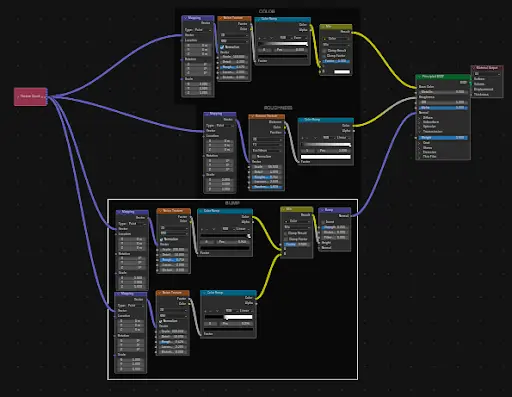
I used Autodesk Fusion 360 to create the model, which I then exported to Blender. Through Blender's shader nodes, I created procedural textures using bump maps, color ramps, and a variety of noise and voronoi textures. I used Photoshop to create the back pixel art graphic and Premiere Pro to implement 2D elements using vector motions and masks, as well as final post-editing.
I used Autodesk Fusion 360 to create the main body of the model aswell as larger components. Blender was used to create smaller details and more intricate parts such as the top adjustment knobs, middle slider, gauges, portafilter and group head. In Substance Sampler I mixed materials untill I had a satisfactory material finish, of which I exported the normalmaps and integrated them with Blenders node shaders. Decals and text was created in Illustrator by importing fonts, finding color values and closely following referenses. For the final touches I used Premiere Pro to adjust the timing to music and add effects such as sharpness, noise and bloom.
I used Autodesk Fusion 360 to create the main body of the model aswell as larger components. Blender was used to create smaller details and more intricate parts such as the top adjustment knobs, middle slider, gauges, portafilter and group head. In Substance Sampler I mixed materials untill I had a satisfactory material finish, of which I exported the normalmaps and integrated them with Blenders node shaders. Decals and text was created in Illustrator by importing fonts, finding color values and closely following referenses. For the final touches I used Premiere Pro to adjust the timing to music and add effects such as sharpness, noise and bloom.
TIME
The planning for the project, consisting of creating an estimated timeframe, time-report sheet and moodboard, took a combined 5 hours. The modeling stage, including modeling and texturing, took a total of 33 hours, with modeling being the largest part, consisting of 22 hours. Lastly, production and post-production, consisting of a motion and material preview, lighting, animation, and post-processing, came to a combined 40 hours, with animation accounting for 24 hours.
The planning for the project, concsiting of creating an estimated timeframe, timereport sheet and moodboard, took a combined 6 hours. The modelling stage, including modelling, uv-mapping and texturing, took a total of 42 hours, with modelling being the largest part, concisting of 29 hours. Lastly, production and post, concisting of a motion and material preview, lighting, animation, and post processing came to a combined 25 hours.
The planning for the project, concsiting of creating an estimated timeframe, timereport sheet and moodboard, took a combined 6 hours. The modelling stage, including modelling, uv-mapping and texturing, took a total of 42 hours, with modelling being the largest part, concisting of 29 hours. Lastly, production and post, concisting of a motion and material preview, lighting, animation, and post processing came to a combined 25 hours.
ESTIMATED TIME: 70h
ESTIMATED TIME: 70h
ACTUAL TIME: 78h
ACTUAL TIME: 78h
PLANNING
PLANNING
PLANNING
MODELING
MODELING
MODELING
PRODUCTION & POST
PRODUCTION & POST
PRODUCTION & POST
SIMON TORSTENSSON
CONTACT
Mail: simonjern@outlook.com
Tel: 0701132999
SOCIAL
Pintrest
Spotify